

Products
product
product
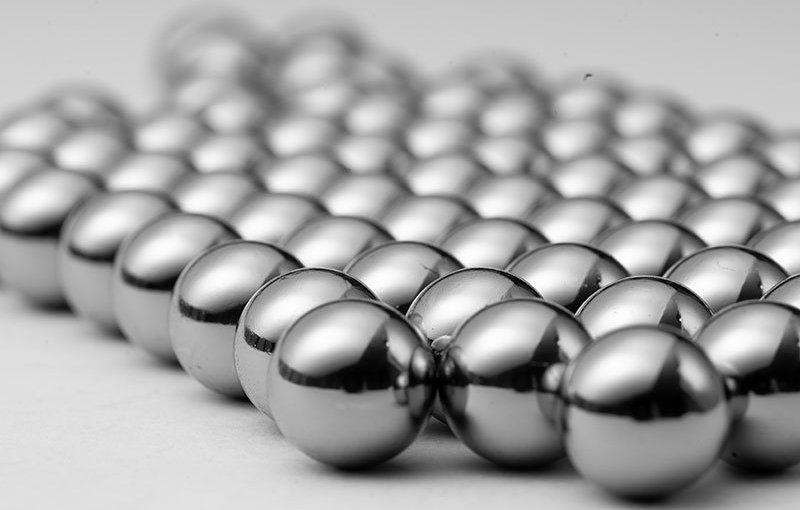
Stainless steel balls are typically produced using a forging process. Commonly used stainless steel ball materials include 201, 302, 304, 316, 316L, 420, and 440C. Stainless steel balls are not rust-proof, but rather rust-resistant. This may not be something you've often noticed, so here's a brief introduction to stainless steel ball standards.
Stainless Steel Ball Standards
Definition: Steel containing at least 12% chromium, which is resistant to chemical attack. Principle: Stainless steel is not rust-proof, but rather rust-resistant. The principle is that the addition of chromium creates a dense chromium oxide layer on the steel's surface, effectively insulating it from air and preventing oxygen from entering the steel, thus preventing rust.
Classification: The China National Standard (CNS), the Japanese Industrial Standard (JIS), and the American Iron and Steel Institute (AISI) use three-digit numbers to designate different stainless steel grades, which are widely used by industry organizations. The 200 series designates chromium-nickel-manganese austenitic stainless steel, the 300 series designates chromium-nickel austenitic stainless steel, and the 400 series designates chromium-manganese stainless steel (commonly known as stainless iron), which includes both martensite and ferrite. Other classifications are based on composition, magnetic permeability, heat-hardenability, and steel grade number. From raw material input to finished product, steel balls undergo multiple inspections and production processes, primarily including cold heading, polishing, heat treatment, hardening, hard grinding, initial grinding, sorting, and final grinding.
1. Raw Material Quality Standards
Ink-specific steel balls are made from GCr15 bearing steel. Based on this, Qingdao Fiter has innovatively produced GCr15SiMn and martensitic stainless steel balls with improved wear resistance. Currently, Fiter is the only company in China to offer a comprehensive product line, and its products are widely used in the ink manufacturing industry.
2. Steel Ball Dimensional and Geometric Accuracy Standards
For steel balls with diameters ranging from 1.2 to 12.7 mm, the ball diameter variation must be ≤ 25 μm; the batch diameter variation must be ≤ 50 μm; the spherical shape error must be ≤ 25 μm; and the gauge value must be ±150 μm (customizable upon request).
3. Steel Ball Crushing Load Standard
This standard is crucial for ensuring that steel balls do not break.
4. Steel Ball Heat Treatment Quality Standard: This standard is crucial for ensuring that steel balls possess high wear resistance and hardness.
If you would like to know more, please contact us at +86 18865261666
If you want more understanding, please contact us.

 WeChat